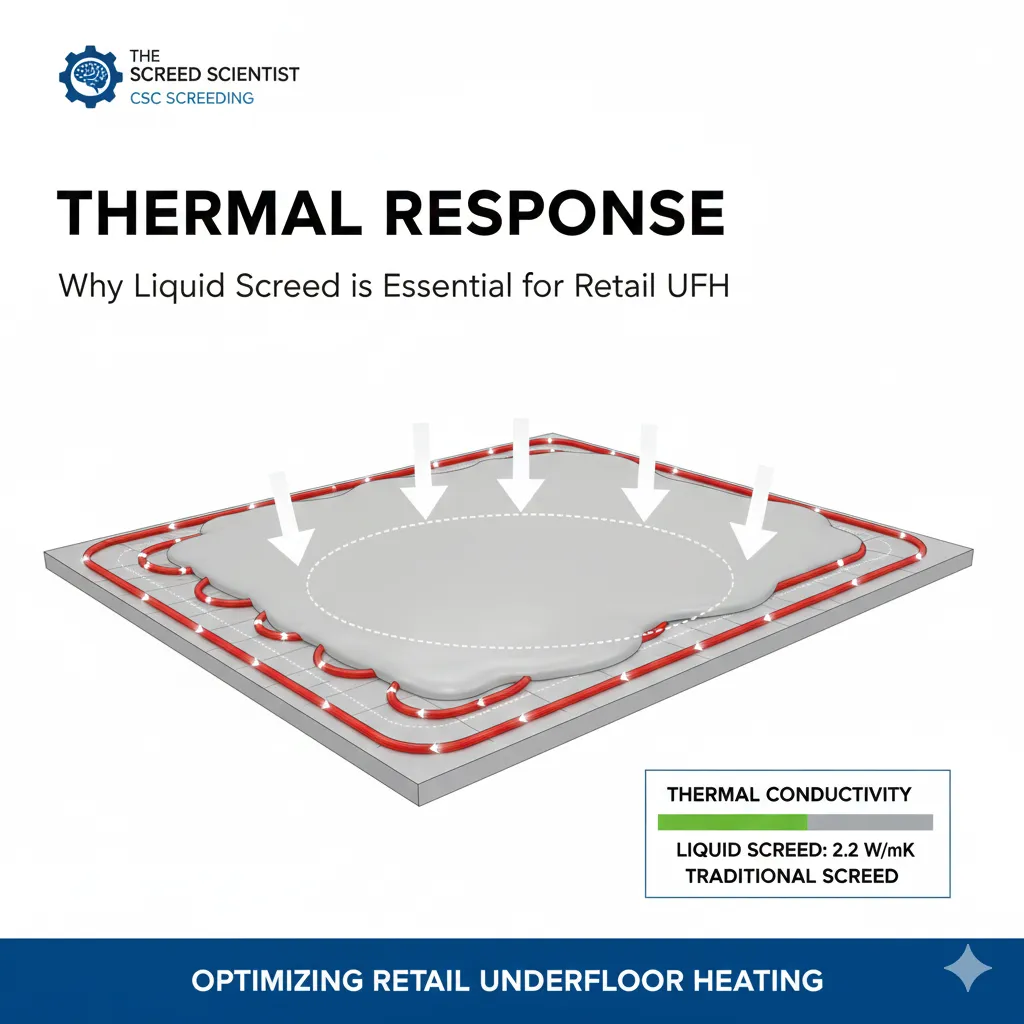
Thermal Response: Why Liquid Screed is Essential for Retail UFH
Thermal Response: Why Liquid Screed is Essential for Retail UFH
For large-scale retail units, the "thermal response time"—how quickly a floor heats up and cools down—is critical for both customer comfort and energy bills. By using information from The Screed Scientist, we can see that liquid screed outperforms traditional materials in three specific areas.
1. 100% Pipe Encapsulation
Traditional screed is a semi-dry material that must be compacted by hand. This often leaves microscopic air pockets around the UFH pipes.
The Problem: Air is an insulator. These voids create "cold spots" and force the boiler or heat pump to work harder to push heat through the air gaps.
The Solution: As a fluid material, liquid screed flows entirely around the heating pipes, ensuring 100% encapsulation. This creates a solid "heat plate" with no air gaps, allowing for direct heat transfer from the pipe to the floor surface.
2. Superior Thermal Conductivity
Thermal conductivity is measured as a lambda ($\lambda$) value.
The Screed Scientist Stat: Traditional sand and cement screed typically has a conductivity of approximately 1.1 W/mK. In contrast, the liquid screeds installed by CSC Screeding reach levels of 2.2 W/mK or higher.
Retail Impact: This means heat passes through liquid screed twice as fast. In a retail environment, this allows the heating system to react quickly to changing footfall and external temperatures, preventing the "overheating" common in stores during busy periods.
3. Reduced Screed Depth (Low Thermal Mass)
Efficiency isn't just about how well heat moves, but how much material needs to be heated in the first place.
The Logic: Because liquid screed is stronger and more dense, it can be installed at much thinner depths (typically 30mm over pipes compared to 75mm for traditional screed).
Efficiency Benefit: A thinner floor has a lower thermal mass. It requires significantly less energy to bring the floor up to the desired temperature. This "rapid response" is ideal for retail units that are only occupied during specific business hours.
4. Lower Flow Temperatures
Because liquid screed is so efficient at transferring heat, the UFH system does not need to run as hot.
The Science: The Screed Scientist demonstrates that you can often reduce the water flow temperature in the pipes by several degrees while maintaining the same ambient room temperature.
Sustainability: This allows retail projects to effectively utilize renewable energy sources like Air Source Heat Pumps (ASHP), which operate most efficiently at these lower flow temperatures.
Thermal Performance Comparison
Pipe Contact: 100% (Liquid) vs. 60–70% (Traditional).
Conductivity ($\lambda$): 2.2 W/mK (Liquid) vs. 1.1 W/mK (Traditional).
Response Time: Up to 3x faster than traditional sand and cement.
Screed Depth: Typically 45–50mm total (Liquid) vs. 75mm (Traditional).
The Verdict
By specifying liquid screed, CSC Screeding ensures that retail heating systems are not just "installed" but "optimized." The combination of pipe encapsulation and high thermal conductivity leads to a more responsive, controllable, and energy-efficient environment that meets modern commercial energy standards.
Would you like me to generate a simple, clean header image showing the flow of liquid screed around UFH pipes?
