Underfloor Heating & Screeding
Send us your plans for a quote and receive a full design service. We design from your GA plans and known heat source, then deliver the complete UFH and screeding package.
Why Choose CSC for Underfloor Heating?
One team handles design, UFH installation, and flowing screed, keeping your programme on track.
Full Design Service
Send us your plans and we design the complete system from your GA drawings and known heat source.
Optimal Heat Transfer
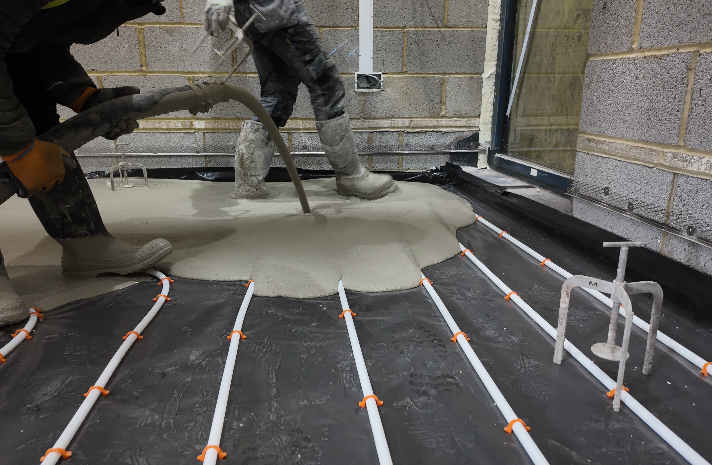
Flowing screed fully encapsulates heating pipes, eliminating air pockets and maximising thermal conductivity.
Faster Programme
Coordinated installation means less time on site. UFH and screed delivered as one seamless operation.
Precision Depths
Accurate screed coverage over pipes at the correct depth for maximum efficiency and compliance.
How It Works
Send us your plans for a quote and receive a full design service.
Send Us Your GA Plans
Email your general arrangement plans along with details of your known heat source to [email protected].
Full Design Service
We design the complete UFH system including pipe layouts, circuit zones, manifold positions, and flow rates, all tailored to your project.
Professional Installation
Our team installs the UFH system to the approved design, including insulation, pipework, manifolds, and pressure testing.
Flowing Screed Application
We complete the package with flowing screed that fully encapsulates the pipework, ready for your final floor covering.
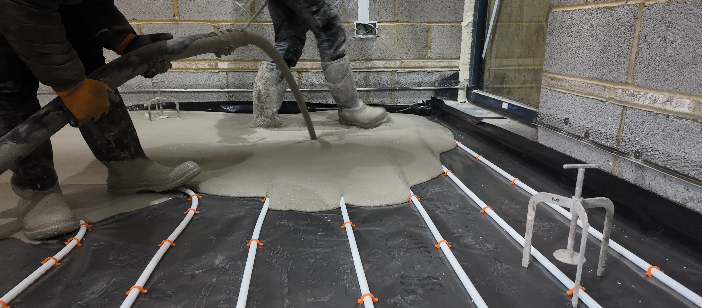
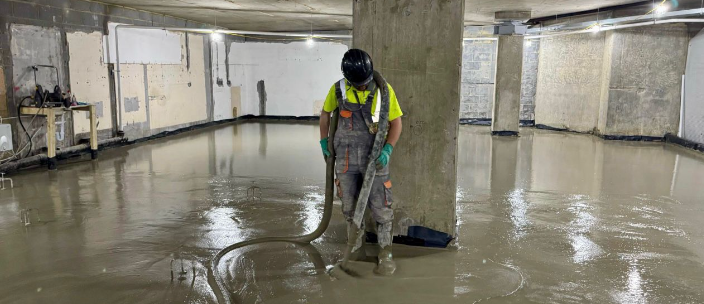
Arundel Great Court
Over 20,000m2 of underfloor heating, designed, installed, and
screeded by CSC.
20,000
m2 of UFH Installed
Full
Design & Install Package
London
Prestigious Riverside

A landmark residential development on the South Bank of the Thames. CSC delivered the complete underfloor heating and screeding package across this prestigious scheme, demonstrating our capability to deliver at scale on the most demanding projects in London.
Suitable for All Project Types
From single properties to 200 unit developments.
New Build Homes
Full UFH systems for new residential builds, designed for efficiency and integrated with our screeding service.
Multi-Unit Developments
Volume installations across apartment blocks and housing developments with programme certainty.
Extensions & Renovations
Retrofit underfloor heating into extensions, conversions, and renovation projects.
Commercial Fit-Outs
UFH systems for office spaces, retail units, and hospitality venues.
Education & Healthcare
Even heat distribution with no exposed radiators. Ideal for schools, nurseries, and care homes.
Heat Pump Compatible
UFH works at lower water temperatures than radiators, making it the perfect partner for heat pumps.
WiFi Enabled Controls
We offer WiFi enabled controls as part of our underfloor heating package. Controls are issued to the M&E contractor to install, or they can source controls separately if preferred.

Frequently Asked Questions
Common questions about underfloor heating and screeding, answered by The Screed Scientist.
Send Us Your Plans Today
Send us your GA plans and heat source details for a quote and receive a full design service. From single properties to 200 unit developments.
Ready to Guarantee Your Programme?
Get a detailed quote with mobilisation timeline, method statement, and programme integration plan.