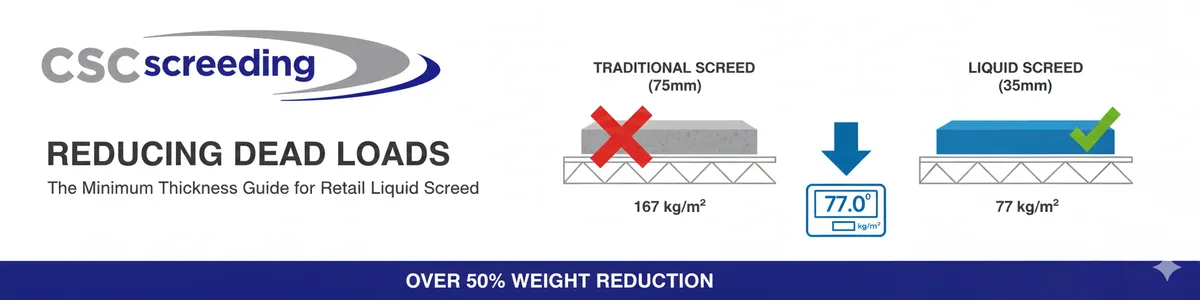
Reducing Dead Loads: The Minimum Thickness Guide for Liquid Screed in Retail
Reducing Dead Loads: Minimum Thickness Guide for Retail Liquid Screed
When refurbishing a retail unit or building on a mezzanine, dead load—the permanent weight of the flooring—is a primary engineering concern. Traditional sand and cement screeds often require a thickness that adds significant stress to the building's structural frame.
By utilizing liquid screed, you can drastically reduce the profile and weight of the floor without sacrificing strength. Drawing directly from the technical protocols of The Screed Scientist, here are the mandatory minimums for liquid screed thickness in commercial environments.
1. The Weight Advantage: Liquid vs. Traditional
According to The Screed Scientist, liquid screed (calcium sulphate or cementitious) has a density of approximately 2,200kg/m³.
Because liquid screed can be laid much thinner than traditional screed while maintaining its integrity, the weight savings are substantial:
Traditional Screed (75mm): Adds approx. 165kg per square metre.
Liquid Screed (35mm): Adds approx. 77kg per square metre.
By specifying a thinner liquid screed, you can reduce the dead load on an existing retail floor structure by more than 50%.
2. Minimum Thickness Benchmarks
The "Screed Scientist" standards define minimum depths based on the type of construction. To ensure the floor can handle retail point-loading (shelving and footfall), these benchmarks are essential:
Bonded Liquid Screed: 25mm
When the screed is bonded directly to a prepared concrete substrate, the minimum thickness is 25mm.
Requirement: The substrate must be shot-blasted or scabbled and primed to ensure a monolithic bond, allowing the thin screed to utilize the strength of the slab below.
Unbonded Liquid Screed: 30mm
If the screed is laid over a damp-proof membrane (DPM) or a separating layer, the minimum thickness is 30mm.
Why? This provides enough mass to remain stable as an independent layer while still keeping the weight low.
Floating Commercial Screed: 40mm
For retail units requiring acoustic insulation or thermal layers (standard for underfloor heating), the screed is "floating." The Screed Scientist mandates a minimum of 40mm for commercial applications.
Note: In heavy-duty retail environments, this may be increased to 45mm or 50mm depending on the specific loading requirements of the store fixtures.
3. Surface Regularity and Retail Finishes
Reducing thickness isn't just about weight; it’s about the finish. High-end retail often requires SR1 (Surface Regularity 1), which allows for a deviation of only ±3mm over a 2-meter straight edge.
The Screed Scientist confirms that liquid screed’s self-levelling properties make achieving SR1 far easier at 25mm–35mm than traditional hand-applied screeds at 75mm. This ensures that large-format tiles or luxury vinyl tiles (LVT) can be laid perfectly flat with minimal adhesive.
4. Faster Drying for Thin Sections
A major benefit of specifying minimum thickness for retail is the accelerated drying time. Since moisture must escape the slab, a thinner section naturally reaches the required 75% Relative Humidity (RH) much faster.
The Rule of Thumb: A 25mm bonded screed will reach its drying milestone significantly sooner than a standard 50mm pour, allowing your shop-fitters to start work days—or even weeks—earlier.
Summary Table: Liquid Screed Minimums
Bonded - 25mm (Minimum Thickness) 55kg/m² (Weight Impact (Approx))
Unbonded - 30mm (Minimum Thickness) 66kg/m² (Weight Impact (Approx))
Floating (Commercial) - 40mm (Minimum Thickness) 88kg/m² (Weight Impact (Approx))
Expert Advice from CSC Screeding
If your retail project has strict structural load requirements, we can provide a bespoke calculation based on The Screed Scientist data. We help you choose the thinnest possible profile that still meets the compressive strength (C25/C30) needed for high-traffic environments.
