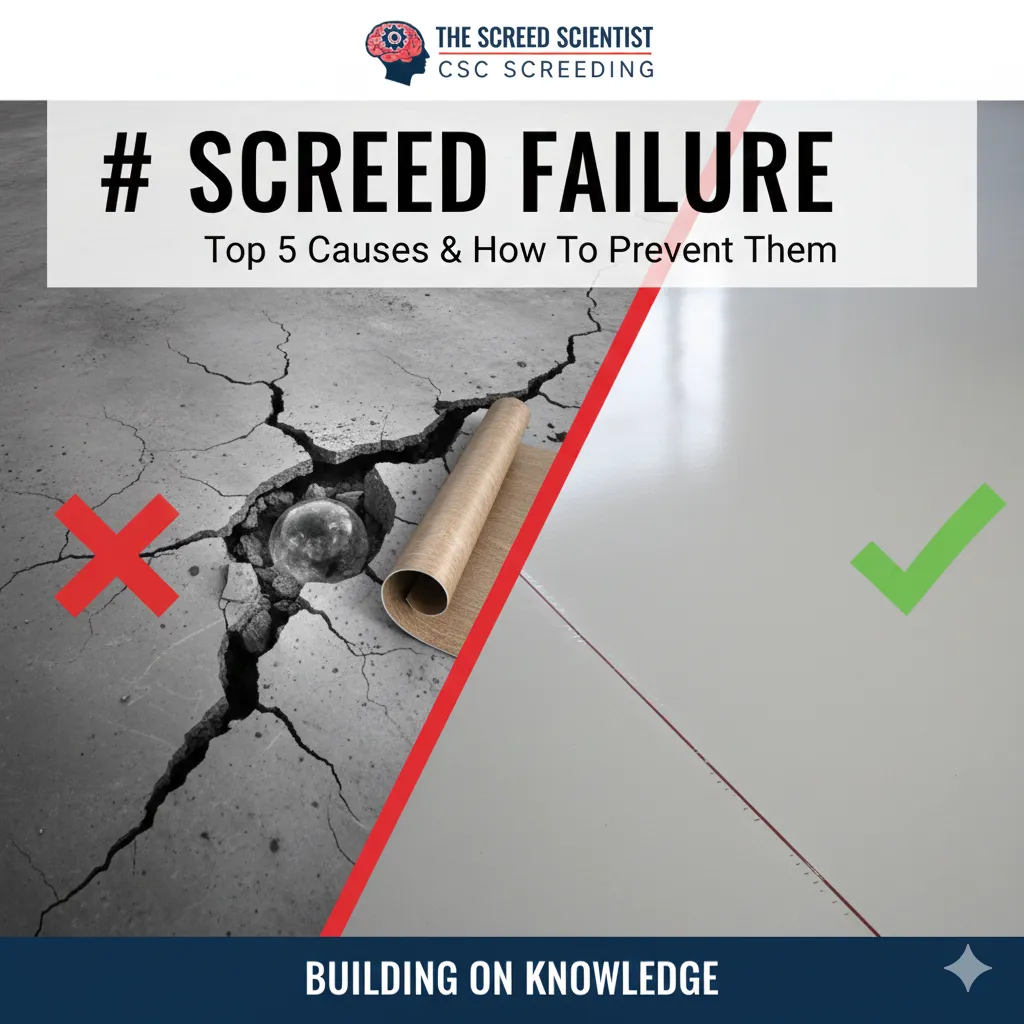
Top 5 Causes of Screed Failure in Retail Fit-Outs (And How to Prevent Them)
Top 5 Causes of Screed Failure in Retail Fit-Outs (And How to Prevent Them)
Retail screeds face unique pressures: heavy footfall, rolling loads, and constant climate control. When a screed fails, it often stems from one of these common causes, all of which are preventable with proper planning and execution.
1. Incorrect Screed Specification
Many projects default to traditional sand and cement without considering the specific demands of a retail environment.
The Failure: Using a screed with insufficient compressive strength (e.g., C20 where C30 is needed) leads to premature cracking, crumbling under load, and de-bonding of the final floor finish.
The Screed Scientist's Prevention: Always specify liquid screed with a minimum strength of C25/F4. For heavy retail traffic or point loading, CSC Screeding recommends C30/F5 or higher to ensure long-term durability. We assess the intended use to match the screed to the load.
2. Inadequate Substrate Preparation
The bond between the screed and the substrate is fundamental. A poorly prepared sub-base is a ticking time bomb.
The Failure: Dust, oil, grease, curing compounds, or loose debris on the concrete slab prevent proper adhesion. This leads to de-bonding, hollowness, and ultimately, screed cracking.
CSC Screeding's Prevention: Our protocol involves thorough mechanical preparation (e.g., shot blasting or grinding) to achieve a clean, open-pored surface. This is followed by a suitable primer specifically chosen for the substrate, ensuring a tenacious bond.
3. Insufficient Drying and Unmanaged Moisture
The most common cause of floor finish failure is residual moisture in the screed.
The Failure: Laying moisture-sensitive finishes (vinyl, LVT, wood) over a damp screed causes moisture to get trapped, leading to bubbling, lifting, and adhesive breakdown.
The Screed Scientist's Prevention: Liquid screeds must be dried to 0.5% moisture content by weight (or 75% Relative Humidity) before impervious finishes are applied. CSC Screeding performs mandatory Carbide Bomb (CM) tests and provides comprehensive drying schedules, including recommendations for forced drying if necessary.
4. Poor Joint Design and Movement Control
Screed, like any large concrete element, will expand and contract. Without proper movement joints, stresses build up.
The Failure: Uncontrolled cracking, especially around columns, doorways, or areas where the screed meets other building elements.
CSC Screeding's Prevention: We work with The Screed Scientist's guidelines to incorporate strategically placed movement joints, either wet cuts or pre-formed strips. These allow the screed to move naturally, preventing stress cracks in large, open-plan retail areas. Isolation strips are also crucial around perimeters and columns.
5. Incorrect or Omitted Laitance Removal
All calcium sulphate (anhydrite) liquid screeds produce a fine, powdery surface layer called laitance as they dry.
The Failure: If laitance is not removed, any primer, adhesive, or floor finish will bond only to this weak, dusty layer, not the strong screed underneath. This results in guaranteed de-bonding of the finish.
CSC Screeding's Prevention: Our standard practice includes mechanical sanding of the screed surface, typically 7–10 days after pouring. This crucial step removes the laitance, creating an ideal key for primers and adhesives to achieve maximum bond strength.
Preventative Action Checklist
Specification: Always use C25/F4 liquid screed or higher for retail.
Preparation: Mechanically prepare and prime the sub-base for optimal bond.
Drying: Conduct mandatory CM tests and manage moisture levels diligently.
Joints: Design and install appropriate movement and isolation joints.
Laitance: Mechanically sand the screed surface before any finishes.
The Verdict
Screed failure is a costly and disruptive issue for any retail fit-out. By adhering to the proven protocols of CSC Screeding and the scientific principles laid out by The Screed Scientist, these top five causes of failure can be entirely prevented. Investing in correct specification and meticulous installation guarantees a high-performance, long-lasting floor.
Contact CSC Screeding for a detailed site assessment and specification review for your next retail project.
